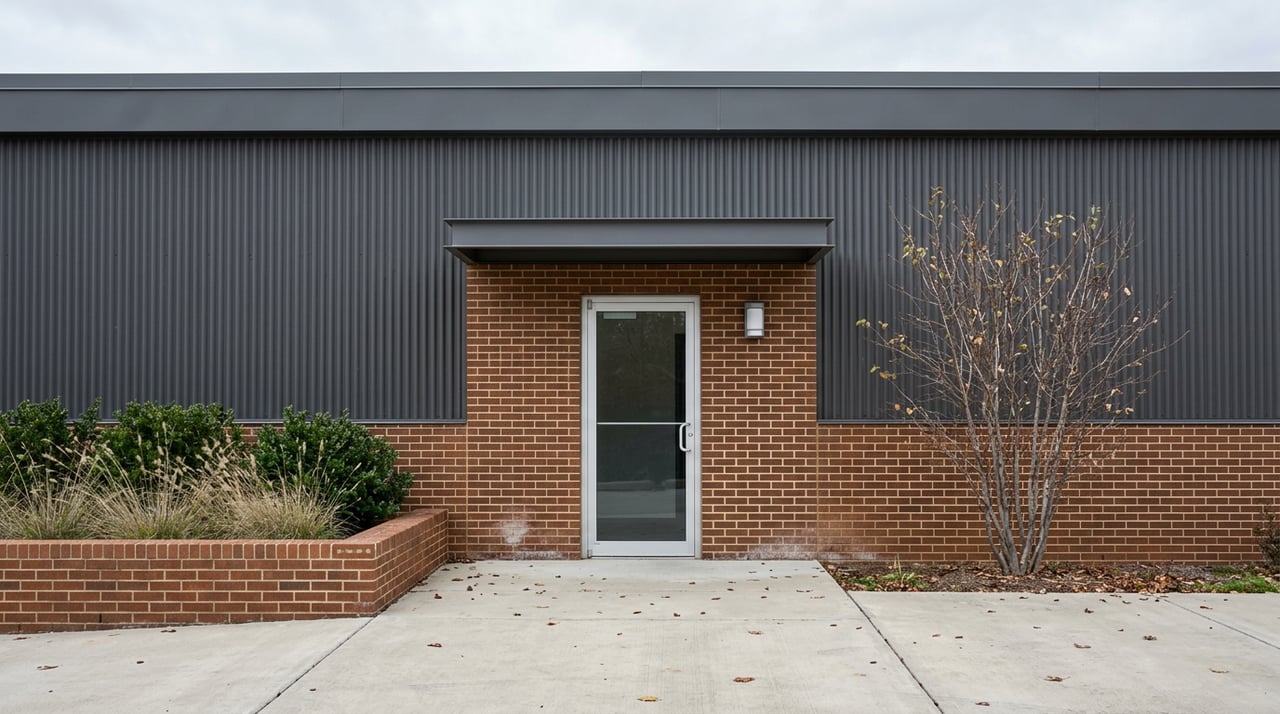
The Data Center That Did Everything Right and Still Got Paused in McMinnville
September 10, 2026
September 10, 2026
Ray and Alex Hixson did not skip a step. By the time anyone outside their circle knew about the project, they already owned the land. It was zoned industrial, sitting along Industrial Drive next to the Habitat for Humanity ReStore. They had a signed power agreement with Bloom Energy for fuel-cell generation, so the facility would not even need to wait in line for a utility interconnection. Fluor Corporation had completed an engineering study and a cost estimate. The site had cleared Phase I environmental review. On paper, the Hixson Data Center was about as close to shovel-ready as a 96,000-square-foot commercial project gets.
Nine days after the public found out about it, McMinnville froze it anyway.
That gap between "did everything right" and "still got stopped" is the part worth sitting with if you're evaluating industrial or commercial land in Warren County right now. Zoning tells you what a parcel is allowed to become on the day you read the code. It does not tell you what a city council will allow once the neighbors find out, or what water and power capacity actually exists once someone runs the numbers. Both of those things just got tested in McMinnville, in public, with a clear before-and-after.
The plan was for a two-level, roughly 96,000-square-foot campus built for high-density AI computing, sized to support the Nvidia GB200 NVL72 platform. Rather than draw from the regional grid, the facility was designed to run largely off it, with Bloom Energy contracted to supply on-site solid oxide fuel cell power, backed by battery storage and diesel generators for redundancy. The developers were targeting a Q1 2028 completion and were, at the time of the announcement, still working to secure financing and a single tenant for the full output.
None of that is a red flag on its own. It is, if anything, a more buttoned-up approach than most commercial land deals arrive with. The site was already owned, so there was no acquisition contingency hanging over the timeline. The zoning matched the use. The environmental homework was done. If you were underwriting this from a spreadsheet, it would have looked close to bulletproof.
The public timeline moved fast. Once word of the project spread, a petition calling for a moratorium on new data center approvals gathered more than 2,600 signatures within days. Mayor Ryle Chastain called a special session for June 3, and after more than 90 minutes of citizen comment, the Board of Mayor and Aldermen unanimously approved a moratorium on data centers, bitcoin mining facilities, microchip manufacturing facilities, and similar high-impact uses on first reading. A second reading finalized the ordinance on June 9, putting an 18-month pause in place that runs into December 2027.
City Administrator Nolan Ming framed it plainly afterward: "A moratorium is not a permanent ban. It is a responsible time-out." The stated purpose is to give the city time to study grid capacity, water and stormwater impacts, and noise before writing new rules, rather than deciding case by case under pressure.
Here is the detail that matters most for anyone buying land here. The site was, and still is, correctly zoned for the use. What stopped it wasn't the zoning code. It was three things that don't show up on a parcel map: how much water the project would draw, how much noise it would put next to homes, and how close it actually sat to a residential area despite being on industrial-zoned ground.
Hixson's own estimates put water use at roughly 3 million gallons a year and noise at about 50 decibels at the nearest property line. Resident Kai Sage, who helped organize the pushback, has said the proposed facility sat near her home and other residential neighborhoods, not tucked away on some remote industrial tract. That's the underwriting gap in one sentence: a parcel can carry the right zoning designation and still sit close enough to a neighborhood that the community treats it as a residential issue rather than an industrial one.
A few numbers worth carrying into any similar deal in Warren County:
McMinnville isn't new to hosting a data center. A 35,000-square-foot facility at 204 Red Road has operated since 2015, built with automatic substation switching arranged through the McMinnville Electric System, in a building that also houses the city's police headquarters. It drew none of this controversy. The difference wasn't the technology or the zoning category. It was scale, proximity, and the fact that it arrived quietly, integrated with a public building the community already understood.
That contrast is the clearest evidence for the thesis here. Two facilities, same broad use category, same city, radically different reception. If you're pricing risk on an industrial parcel, "there's already a data center in town" tells you almost nothing about whether the next one clears. What matters is how close it sits to rooftops, how much it visibly draws from shared infrastructure, and how the announcement is handled before anyone outside the deal room hears about it.
The June 9 ordinance covers land inside McMinnville's city limits. It does not automatically extend to unincorporated Warren County, where a large share of the area's raw acreage and industrial-adjacent land actually sits. Warren County commissioners were expected to take up their own version of the moratorium later that same month, following the same pattern seen in neighboring Coffee County, which passed a parallel measure the same week.
If you're looking at land outside the city boundary, don't assume the city's rules apply, and don't assume they don't. Given how quickly this moved in June, confirm the current status directly with the Warren County Commission before you treat "outside city limits" as a way around the pause.
A few questions worth asking before any offer on industrial, commercial, or larger-scale multifamily land in Warren County over the next 18 months:
McMinnville isn't closing the door on industrial growth. The city has spent years courting exactly this kind of investment, and the moratorium's own language says as much. What changed in June is that the path from zoning approval to groundbreaking now runs through a public conversation the city is actively rewriting the rules around. For anyone underwriting land here, that's not a footnote. It's the deal.
If you're evaluating a commercial or industrial parcel in Warren County, or trying to figure out how this moratorium touches a specific piece of land you already have under consideration, The Wingate Group works this market from the inside, not just the listing sheet. Schedule a consultation and we'll walk the actual constraints on your parcel together before you make an offer.
Stay up to date on the latest real estate trends.
Make BIG Money with your home!
We pride ourselves in providing personalized solutions that bring our clients closer to their dream properties and enhance their long-term wealth.
GET IN TOUCH WITH OUR TEAM TO LEARN MORE
THE WINGATE GROUP
119 W MAIN ST STE 7 MCMINNVILLE, TN 37110